



By Cristina De Silva, Technical Innovation Director, LATAM, Bellis Food Solutions
Ask most people what sugar does in candy and they'll say "it makes it sweet." That's true, but it's only a small part of the story. In a hard candy, a gummy, or a chewy caramel, sugar is also the bulk of the piece, the reason it holds its shape, the source of its color, the thing keeping it from crystallizing, and a big part of how it stays fresh on the shelf.
That's why reducing sugar is harder than swapping in a sweetener. When you remove sugar, you remove all of those jobs at once. This article walks through each job, then shows which tools in the low-sugar toolkit can take it over.
Consumer demand is one reason. Regulation is another. Over 130 jurisdictions have introduced taxes on sugar-sweetened beverages, and countries such as Mexico, the UK, and South Africa have documented drops in consumption after those taxes took effect. Schools in Mexico have removed ultra-processed foods, and California has a proposed bill to do the same. Confectionery is not the main target of most of these measures, but it sits in the same conversation, and brands are increasingly expected to show they are taking sugar seriously.
When we talk about sugar in candy, we usually mean the mono- and disaccharides, mainly sucrose (table sugar) and glucose from corn syrup. In most formulas, they work in several roles at once:
• Sweetness and flavor. Sugar sets the sweetness level and enhances other flavors.
• Bulk and structure. Sugar and corn syrup make up most of the dry solids. They give a candy its body, its volume, and much of its texture.
• Crystallization control. The ratio of sucrose to glucose syrup determines whether a candy crystallizes or not. It will depend on the type of candy if this is a desired or undesired characteristic.
• Color and browning. Reducing sugars take part in Maillard and caramelization reactions, which give baked and cooked confections their caramel color and develops multiple flavor compounds.
• Water activity and shelf life. Sugar contributes in decreasing the water activity, which is utterly important in preventing microbial growth at the right levels.
• Texture and mouthfeel. Sugar contributes to chew, snap, melt, and the way a candy feels as it dissolves. It´s properties of crystallization or remaining in glassy state will define the mouthfeel in a candy.
Once you see sugar as a set of functions, the reformulation question changes. You are no longer asking "what replaces sugar?" but "what replaces each of these jobs, and which ones does this product actually need?"
Each tool in the toolkit fits a different job. None is a drop-in replacement for sugar as a whole.
Sugar alcohols (polyols). Isomalt, maltitol, sorbitol, mannitol, xylitol, erythritol, and lactitol are made by chemically modifying sugars. They provide bulk, moderate sweetness, and humectancy, and they are less likely to crystallize. Two cautions: they don't brown through Maillard reactions, and they are only partially absorbed in the gut. At high doses they can cause laxative effects, so labeling warnings are often required. Erythritol is the exception, since it is largely absorbed in the small intestine and has no laxative threshold of the same kind. Polyols also have a cooling effect in the mouth and are generally considered better for dental health.
Rare sugars. Allulose and tagatose are the best known. Allulose provides sweetness with far fewer calories than sucrose, and it has no aftertaste. Unlike polyols, it can take part in Maillard reactions, which makes it useful for browning and flavor. It also controls crystallization well. Tagatose, the other rare sugar most often used in candy, is about 92% as sweet as sucrose and behaves much like sucrose in taste and bulk. It provides roughly 50% fewer calories and has prebiotic potential. Like allulose, it takes part in Maillard reactions, so it contributes to browning and flavor but it does crystalize so it provides different capabilities compared to allulose.
Bulking fibers and high-molecular-weight carbohydrates. This group includes soluble vegetable fiber, polydextrose, inulin, fructooligosaccharides (FOS), isomaltooligosaccharides (IMO), and hydrolyzed starch hydrolysates. They are mainly used for bulk and as replacements for the corn syrup portion of a formula. They have much lower sweetness than sucrose that is why they are often used along High Intensity Sweeteners. Some are viscous and some are not, some dissolve well and some don't, and some are fermentable enough to cause stomach discomfort at higher levels this will depend on source and chemistry of the fiber.
High-intensity sweeteners. We have the artificial ones: Aspartame, sucralose, acesulfame-K, neotame, saccharin, advantame; and the natural ones: stevia, monk fruit, and brazzein. They all provide intense sweetness, going from 200 to 2000 times sucrose sweetness, in very small amounts. They can make up the sweetness that bulk ingredients can't deliver, but they do nothing for bulk, texture, or crystallization. They are regulated as food additives unless they have GRAS status.
Hydrocolloids and starches. Pectin, gelatin, and modified starches help with chew and texture in particularly in some confections. A bulking agent that replaces sugar is needed, experiment with different types, proportions and mixes to get the desired texture.
Here is a practical way to work through a formula.
Step 1: Decide the claim. Are you aiming for a small sugar reduction, a "no added sugar" claim, or a fully sugar-free product? Do you also need natural, vegan, organic, gluten-free, or non-GMO claims? The answers narrow your choices quickly, because some ingredients are not compatible with certain claims.
Step 2: Map the functions. Use the questions below as a checklist for your formula:
• What flavors are you using? Some polyols with cooling effect are very suitable for minty flavors.
• What will replace the body and texture?
• Does the product need to crystallize, or do you need to prevent crystallization?
• Is the base sweet enough, or do you need a high-intensity sweetener?
• What role does color or browning play?
• What does moisture retention mean for shelf life?
Step 3: Match each function to a tool. The table below summarizes the options.
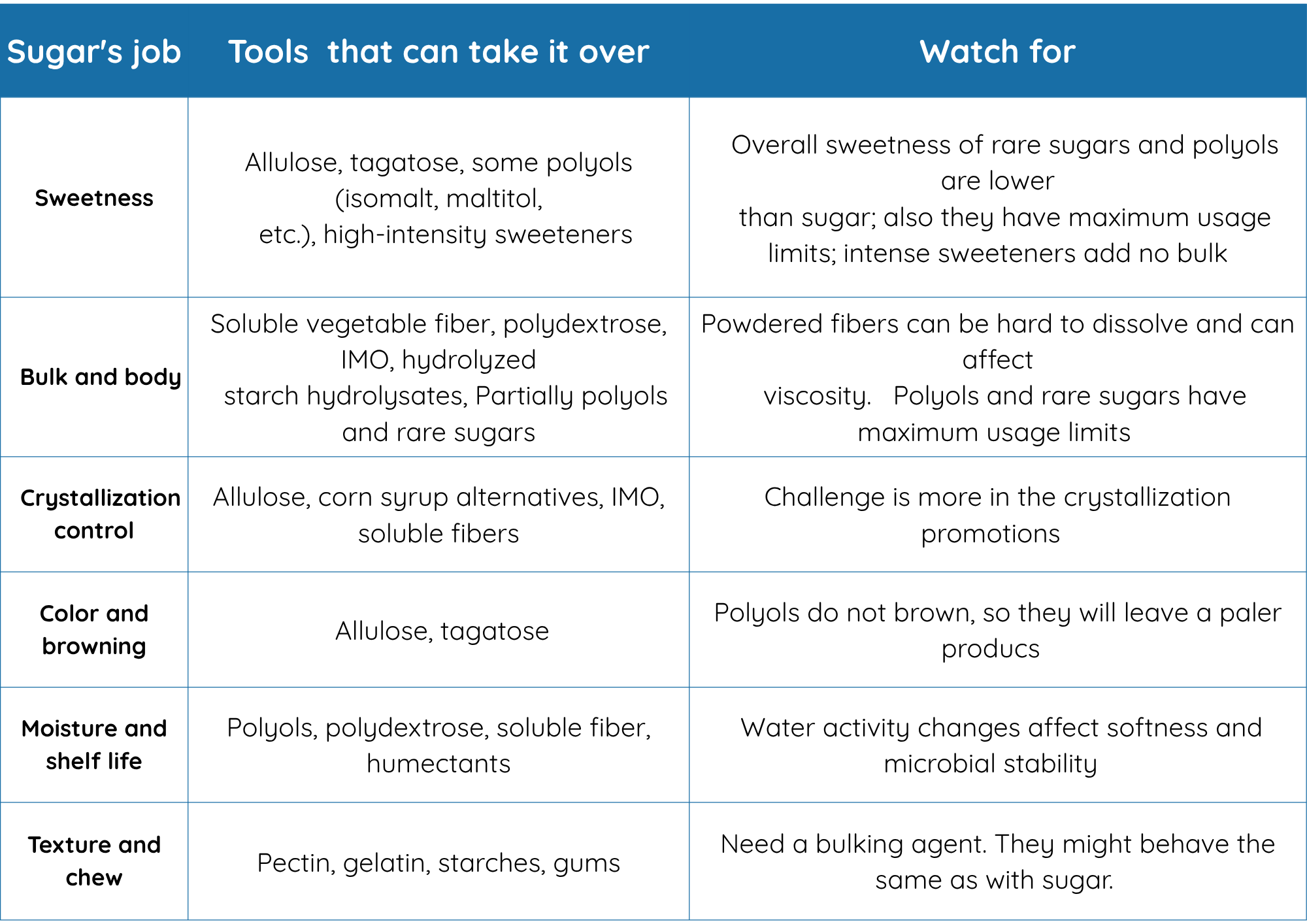
Step 4: Recognize the trade-offs. Some choices in step one may not be compatible with each other. A "no added sugar" claim may limit the bulking ingredients you can use as some have residual sugars. A chewy texture may require starch or hydrocolloid systems that change the flavor release. A balanced formula usually comes from adjusting several tools together, not from finding a single perfect ingredient.
Ingredients that work well on the bench can cause trouble on the production line. Plants are built around traditional sugars, including their equipment, piping, and supply. New ingredients bring new challenges:
• Syrups and totes may need preheating before they can be pumped.
• Powdered fibers with high molecular weight can be harder to dissolve and disperse than sucrose.
• Minor ingredients added through automated continuous systems, such as high-intensity sweeteners, may need special dosing adaptations.
• Viscosity and flow behavior can change, which affects depositing, cooking, and pumping.
• QC teams need retraining on new test methods and specifications, such as water activity that will read lower with polyols at the same solids percentage.
If you are scaling up a low-sugar product, bring your processing team in early. The best formula can still fail if the process is not adjusted for it.
Sugar alternatives are regulated differently across markets. Some ingredients are GRAS in the United States but not approved elsewhere, so a product that is legal in one country may need reformulation for another. Many alternatives have maximum use levels. For example, the FDA's GRAS notice for allulose sets maximum levels for different applications, including candy. Polyols often require a laxative warning above certain thresholds. Rules for "no added sugar" and "sugar-free" claims also vary by country, so check them early, before packaging is designed.
Consumers are often unfamiliar with allulose, polyols, and rare sugars. Clear ingredient lists and simple explanations help. A front-of-pack claim such as "allulose provides sweetness with fewer calories" can build trust, as long as it is accurate and compliant. Misinformation can drive purchasing decisions just as much as the formula does.
***Any labeling or regulatory decision for your product should be reviewed with a qualified food law or regulatory expert in each market where it will be sold
1. Start with the claims. Decide what you need to say on the label before you choose ingredients.
2. Build a formulation plan with your R&D team. List the product characteristics that matter most: texture, flavor, shelf life, and processing.
3. Understand the impact on processing. Work with process experts early to adjust equipment and procedures if needed. A successful formulation is a combination of both formula and process adjustments.
4. Test, taste, and iterate. Expect several rounds. Each round should change one or two functions at a time, so you can see what caused each effect.
Sugar reduction in candy is no longer a guessing game. Ingredient technology has advanced, and our understanding of formulation science has deepened. Low-sugar confections can be as indulgent as their full-sugar counterparts. The key is smart formulation, expert guidance, and a clear strategy for the market you're targeting.
________________________________________
Have questions about Sugar reduction formulation or want to share your own experience? reach out through Candy Mentor at hello@candymentor.com. This is exactly the kind of nerdy confectionery conversation we like.
— Cristina DS
________________________________________
Candy Mentor is a confectionery education platform founded by Michelle Schwenk, Ph.D. Learn more at candymentor.com

