


Tagatose
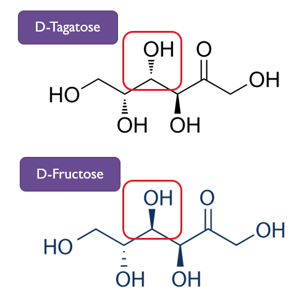
What is Tagatose? Tagatose is a rare sugar that tastes like sugar but contributes fewer calories. It occurs naturally in small amounts in heat-treated milk, some fruits, and cacao, but commercial tagatose is made from lactose in whey or from corn or tapioca starch. Its molecular structure is a six-carbon ketohexose, the C-4 epimer of fructose, and because the body absorbs only part of it, it adds fewer calories than sucrose.


How is Tagatose made? Where does Tagatose come from?
Tagatose occurs naturally in small amounts in heat-treated milk, some fruits, and cacao. Commercial production can start from either lactose in whey or starch from corn or tapioca. The older alkaline chemical method converts galactose from lactose into tagatose at high temperature in a batch process, which can create side reactions and off-colors. Enzymatic processing is now the preferred route: a series of enzyme steps converts starch-derived or whey-derived sugars into tagatose, followed by purification and crystallization. The enzymatic route gives higher purity, typically 98% or more, with better sensory quality and less browning.
What is the Molecular Structure of Tagatose?
Tagatose (D-tagatose, CAS No 87-81-0) is a ketohexose, a six-carbon sugar and it is the C-4 epimer of fructose, meaning one carbon is arranged differently. That single difference changes how the body handles it. Only part of the tagatose is absorbed in the small intestine, and the rest is fermented in the colon. This is why it contributes fewer calories than sucrose.
What are the properties of Tagatose?
• Sweetness: ~92% of sucrose, with a clean, sugar-like taste.
• Calories: About 1.5 kcal per gram, the value FDA uses for labeling.
• Glycemic response: A glycemic index of about 3 (glucose = 100) appears in published tables.
• Browning. Tagatose is a reducing sugar, so it takes part in Maillard browning with amino acids and proteins and in caramelization reactions. That makes it useful for caramel flavor and color, but it also means cooking temperature and time need tighter control. In caramels, expect more color at the same cook temperature than with sucrose, and reduce time or temperature to compensate.
• Crystallization. Tagatose crystallizes readily during cooling. In fondant, grained nougat, grained marshmallow, fudge, panned candy, and crystallized hard candy, that is an advantage, because the crystals create the texture the product needs. In gummies and clear hard candy, it is a risk. Doctoring agents such as corn syrup or soluble fiber slow crystal formation, and a glassy hard candy generally needs them at higher levels.
• Water activity depression: In a comparison of tagatose and sucrose at 20°C, tagatose lowered water activity more than sucrose at the same percentage of solids. That helps control microbial growth and softness in finished confections.
• Hygroscopicity: Tagatose is less hygroscopic than fructose and sorbitol, so it absorbs less moisture from the air. Below about 85% relative humidity, it stays dry.
• pH stability: Tagatose is stable between about pH 2 and 7, which covers most confections.
• Solubility: Highly soluble in water, and its solubility increases with temperature.
What is Tagatose function in confections?
Tagatose gives confections sugar-like bulk and sweetness with fewer calories, which makes it useful for sugar reduction as it can substitute most of sucrose functions. Even more interesting tTagatose is one of the few ingredients in the sugar reduction toolkit that can crystallize, which makes it a great tool for formulators. That crystallization is an advantage in some confections and a risk in others. It also lowers water activity more than sucrose at the same solids, which helps control softness and microbial stability. It browns more readily than sucrose, so cook temperature and time need tighter control.
Where tagatose crystallization helps:
- Fondant
- Grained nougat
- Grained marshmallow
- Fudge
- Panned candy
- Crystallized hard candy
In gummies and clear hard candy, that same tendency needs to be controlled with doctoring agents such as corn syrup or soluble fiber.
What is the regulatory status of Tagatose?
Tagatose has three GRAS notices on file with the FDA: GRN 000078 (2001), GRN 000352 (2010), and GRN 000977 (2021). Under GRAS, the company determines that the ingredient is safe for its intended use.
In November 2025, FDA said it intends to exercise enforcement discretion and exclude tagatose from the Total Sugars and Added Sugars declarations on the Nutrition Facts label. That position is temporary and pending future rulemaking. Tagatose still counts toward Total Carbohydrate and must appear in the ingredient list. Check the rules in each market where the product is sold.
The FSA’s 2025 assessment (RP1652) says D-tagatose was originally authorized in December 2005, under the European Union novel food rules then in force (Regulation (EC) 258/97), at the request of Arla Food Ingredients. It is now on the novel food list under Commission Implementing Regulation (EU) 2017/2470. FSA RP1652
In Mexico, D-tagatosa (synonym “tagatosa”) is listed in ANEXO VIII of the COFEPRIS “Acuerdo por el que se determinan las sustancias permitidas como aditivos y coadyuvantes en alimentos, bebidas y suplementos alimenticios,” under section 12 “D-TAGATOSA,” dated 1 December 2020. It is allowed for all GMP categories, with no maximum limit listed. gob.mx ANEXO VIII
For table sweeteners containing tagatosa, the annex requires a laxative warning: “EL CONSUMO EXCESIVO DE ESTE EDULCORANTE PUEDE CAUSAR EFECTOS LAXANTES.” gob.mx ANEXO VIII
This article is sponsored by TagSweet Crystalline Tagatose from Advanced Ingredients. Learn more at advancedingredients.com/product/tagsweet.
Author: Dr. Michelle Schwenk, Bellis Food Solutions
Dr. Michelle Schwenk is a confectionery scientist and co-founder of Candy Mentor. She holds a PhD from the University of Illinois, where her research focused on sugars and sugar substitutes. She has spent more than 20 years teaching confectionery at candy schools and now works with Bellis Food Solutions on product development and education for the candy industry.
References:
• Schwenk, M. (2021, April). The benefits of sweetening with allulose. The Manufacturing Confectioner, 41–42.
• Ortiz, A. d. C., Fideles, S. O. M., Reis, C. H. B., Pagani, B. T., Bueno, L. M. M., Moscatel, M. B. M., Buchaim, R. L., & Buchaim, D. V. (2024). D-Tagatose: A Rare Sugar with Functional Properties and Antimicrobial Potential against Oral Species. Nutrients, 16(12), 1943. https://doi.org/10.3390/nu16121943
• Oh, D.-K. (2007). Tagatose: properties, applications, and biotechnological processes. Applied Microbiology and Biotechnology, 76(1), 1–8. https://doi.org/10.1007/s00253-007-0981-1
• F. S. Atkinson, K. Foster-Powell, and J. C. Brand-Miller, “International tables of glycemic index and glycemic load values: 2008,” Diabetes Care, vol. 31, no. 12, pp. 2281–2283, 2008.
• U.S. Food and Drug Administration. (2001, October 25). Response to GRAS Notice No. GRN 000078 for D-tagatose [Letter]. https://hfpappexternal.fda.gov/scripts/fdcc/index.cfm?set=grasnotices&id=78
• U.S. Food and Drug Administration. (2011, February 1). Response to GRAS Notice No. GRN 000352 for D-tagatose [Letter]. https://hfpappexternal.fda.gov/scripts/fdcc/index.cfm?set=GRASNotices&id=352
• U.S. Food and Drug Administration. (2021, October 21). Response to GRAS Notice No. GRN 000977 for D-tagatose [Letter from Susan Carlson]. https://www.fda.gov/media/155443/download
• FDA, October 19, 2020 (allulose guidance): Federal Register notice on the 0.4 kcal/g factor and the sugars exclusion. https://www.govinfo.gov/content/pkg/FR-2020-10-19/html/2020-22901.htm
